My guide on the New Orleans Premier Ghost, Voodoo & Vampire Walking Tour was a woman named Nikki. She wore polka-dotted sneakers, a black newsboy cap and a bright red lip; she carried a cane with a silver duck’s head on its end and a crushed Poland Springs water bottle. The water bottle was a strategic prop. She sipped from it when forgetting her lines. Nikki was not a particularly captivating storyteller, often interrupting her train of thought with tangents about her own life, but her sass and distinctly millennial sense of humor made for a memorable afternoon.
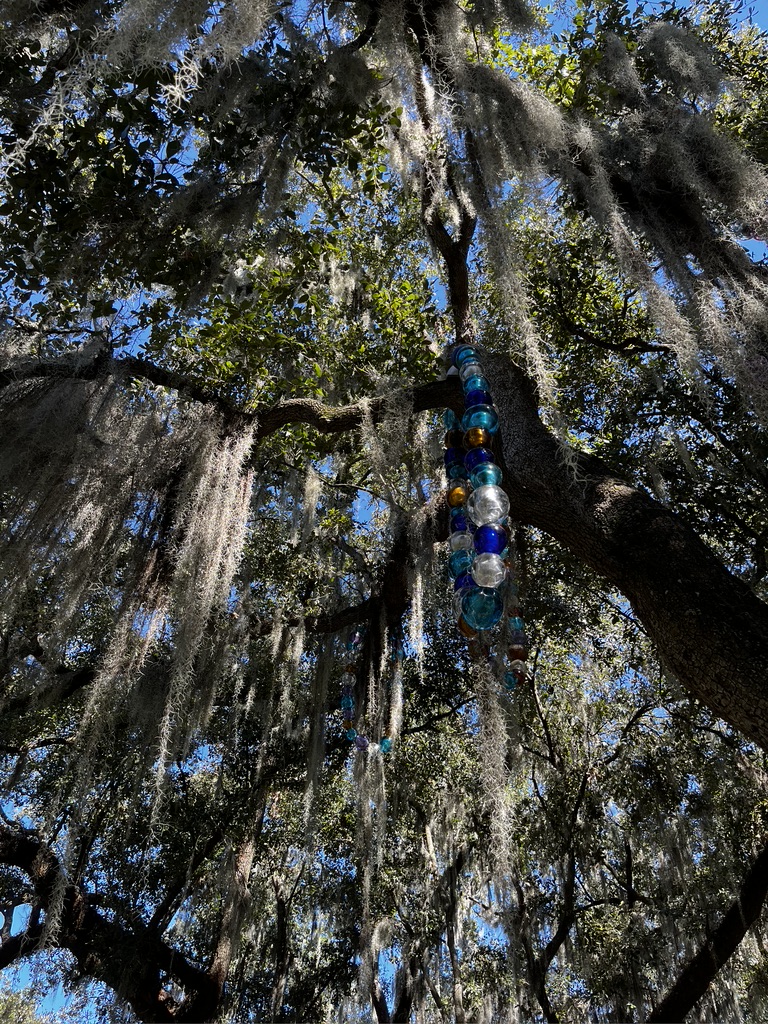
It was a warm day for October, and I wore my sweatshirt around my waist, tied into a clunky knot. Up until this point in time, the furthest south I had ever traveled in the states was D.C. My first day in New Orleans, I could not pull my eyes from the Spanish moss covering every tree, draped around the branches like silk clothing. We do not have this, or anything like this, in New York.
Our intimate tour group convened outside of Pirate King Coffee, a gimmicky cafe in the French Quarter commemorating a man named Jean Lafitte, who smuggled coffee beans from the Caribbean into Louisiana during the 19th century. Of the other participants, my friends and I were the youngest by at least two decades. Nikki promised us an hour-and-a-half of haunted history and flashed a laminated QR code attached to her Venmo account, for tips. “Let’s go!”
One of the first stops on the tour was the Omni Royal Orleans, an upscale hotel located just off Bourbon Street. Nikki gestured to the roof with her cane and told us the story of Zackery Bowen, who leapt to his death in 2006 and now roams the building as a ghost. Just before committing suicide, Bowen wrote a note with the directions to his apartment shared with girlfriend Addie Hall and a confession: He had strangled her 11 days prior. When the police arrived at the apartment, they found chopped remnants of Hall’s body in the oven, in the refrigerator and on the stove. “He was on a one stop train from Snort Lauderdale to Tweak-istan,” Nikki said, referring to Bowen’s cocaine addiction.
Nikki then led us to the Old Ursuline Convent, originally built by Governor Étienne Perier and designed by Ignace François Broutin in the early 18th century as a hospital and boarding home for nuns. In 1728, a group of casket girls—French women who moved to the Louisiana colony seeking to marry and balance out the population’s gender imbalance—arrived at the Convent. But after a series of mysterious deaths and disappearances, rumors spread that the Ursuline casket girls were vampires. Believing their suitcases to be beds of the undead, the nuns running the Old Ursuline Convent sealed them shut with nails blessed by the Pope. Nikki passed around a photograph she had taken last year capturing a ghoulish, translucent face in the third-floor window to a chorus of oohs and aahs. I did not see the face, but nodded appreciatively anyway.
As we made our way to Lafitte’s Blacksmith Bar, Nikki pointed to an adorable blue cottage—her former home. When she moved to New Orleans two years ago, she sublet the house from a friend’s friend, but eventually moved out because a jealous spirit named Oscar kept flickering the lights and shaking the floorboards every time she brought home a male guest. “There are ghosts all over New Orleans, so it was not a big deal,” she explained. “But after he started sleeping next to me in bed, I knew I had to go.”
Her affection and insouciance towards “Oscar” was surprising to me, but not, as I learned over the course of my five-day trip, uncommon to this city. New Orleans is widely regarded as the most haunted place in the country, a fact its residents seem to accept without resistance or fear. The undead appear to coexist peacefully, though sometimes mischievously, with the living. I cannot pretend to be a believer in the paranormal, despite Nikki’s valiant, financially-motivated efforts to convince me otherwise. Still, I respect the New Orleans approach to death. The unknown is not fearful, but family.
 Home
Home 